Monday, May 24, 2010

The Exception?

Over the weekend I remembered that the original CSI (Las Vegas) features Lawrence Fisburne, African-American actor, as a main character. He plays Dr. Ray Langston, who joins the CSI team just as night shift supervisor Gil Grissom retires. Grissom was considered the main character and received a majority of the show's screen time. The timing of Langston's arrival paired with Grissom's departure indicated that Langston would play a major role on the show.

Now, I do not watch this show on a regular basis, but from the few episodes that I have seen Langston is certainly a key character. I saw the first episode that featured Langston, and despite his future as a main character there were elements of tokenism during the show. One example I noticed was how Langston is judged for being a nice dresser. Below is a preview for this episode, the season 9 opener. Take note of the other CSI's initial impressions of Langston (especially at :20!)


For those of you who watch this show regularly, can Langston truly be considered the exception to the apparent tokenism in network TV dramas?

But more importantly, to the general public, how did CBS set up your initial perceptions of Langston? Was he portrayed more as token character or as a main character?

Saturday, May 22, 2010

Media and Democracy and Identity: AmStudDay Review


After hearing Idris Goodwin, Kevin Coval, and James Fallows speak at American Studies Day, I was absolutely amazed at what they had to say! Fallows's speech about media and democracy really made a lot of sense to me and I loved learning about the importance of media working to serve the public rather than profits. When he discussed the media's necessary role of informing the American public, I wondered about the other ways the media informs Americans as well.

As I listened to Goodwin and Coval perform their poems about their own identities, I thought back to what Fallows said about media and democracy. Media is not only important in creating a democracy but also in creating individual identity. When Goodwin spoke about being 'black' and all the representations of that color it seemed apparent that the media played a part in forming those interpretations. The ways African Americans are portrayed in the media and on the news are bound to contribute to an African American's view of themself.

In my case, the media has certainly served to inform me about my identity as a student living in the North Shore. We have talked about this in class before, but the North Shore is certainly quite different from the rest of the world and ultimately those differences are demonstrated by the media.

How has the media contributed to your own identity? In what other ways does the media affect your life?


Tuesday, May 18, 2010

Some Data-Driven-ness at Harvard


Adam Wheeler, a senior at Harvard University, was recently convicted of larceny (when a person steals someone's belongings and uses them for their own good) and identity fraud. After Wheeler's application for the distinguished Rhodes and Fulbright scholarships seemed suspicious to Harvard English Professor James Simpson, his application was investigated further. Simpson determined that Wheeler had plagiarized the writing of another Harvard professor, and upon further investigation it turned out that Wheeler changed his transcript and changed/added to the letters of recommendation professors had written for him.


This scandal caused Harvard to additionally examine Wheeler's background information before being accepted to the university. Wheeler claimed he went to high school at Phillips Academy in Andover and additionally spend a year at MIT before Harvard. His SAT scores (a perfect 1600), high school recommendation by the director of college counseling, letters of recommendation from MIT professors, and MIT transcript were all faked.

Personally I cannot believe an academic institution like Harvard failed to do a background check on at least some of Wheeler's information. A school that prides itself on excellence relied on numbers and written information to admit Wheeler, and the lack of communication in the admissions process of this student astounds me. Clearly Harvard assumed that a student with a "qualified" written background could be accepted. This reliance on written data can clearly cause problems concerning believability and truth. Truth is found through the use of different types of sources, not just statistical data.

What are your reactions to this situation? How does it reflect on America's education system?

This is an article from the Boston Globe that describes the situation in greater detail.

Wednesday, May 12, 2010

The End of Junior Theme

It feels great to finally be done with Junior Theme! Overall it really served as an important learning process for me in junior year. It was challenging to simultaneously work on different parts of the paper. I always struggle putting my thoughts on paper and for me that was probably one of the most difficult things about junior theme. It took a very long time, but eventually I had a rough, and I mean rough, draft. During the editing process I additionally struggled to determine the best way to organize my paper. I moved around paragraphs, eliminated some pieces of information, and constructed new paragraphs in order to complete my final draft. This was certainly a long process for me and after all the hard work I put into it I was glad to at last hand it in.

As I researched the reasons for declining newspaper circulation, I found information in one of my sources about the way democracy in America is affected by declining newspaper circulation. For the United States to have an effective democracy, Americans must be well-informed about news within our country. Cutting costs at newspapers is certainly changing the amount of information Americans receive about the country. So, I definitely have background knowledge about the things James Fallows will talk about during American Studies Day!

Monday, April 19, 2010

Update on Junior Theme

Over the weekend I emailed a possible interviewee, Pablo Boczkowski, a professor in the department of communication studies at Northwestern. He hasn't responded yet so I will try to send him another email in a day or so and in the meantime I am emailing a reporter for the Chicago Tribune and the authors of my book. I do have a thesis, but it is definitely not as clear as it should be. The main idea of my thesis is that the corporate takeover of small newspaper businesses has caused the decline in profits and readership in the newspaper industry. However, I haven't found a clear/concise way to say that. Its also been slightly difficult to find sources that specifically talk about this idea, as most discuss the way the internet plays a roll in the declining newspaper industry. So overall I have certainly made some progress but I am looking to make some leaps this week in actually writing parts of my paper.

Good luck to everyone on their papers!

Thursday, April 8, 2010

Beginning Junior Theme... AH!

After jumping around from different topics, yesterday I came to a final decision about what I am going to write about for Junior Theme. At first I was thinking about researching how students are becoming more and more success-driven instead of being learning-driven. But after I thought about it for a while I lost interest in that topic. One of my initial thoughts was to write about something concerning communication in America and how Americans think in certain ways. Then I thought about the newspaper industry and how nowadays many newspaper companies are shutting down. The change in the way America wants to obtain the news is very interesting to me. So my tentative why question is:

Why is the newspaper industry in decline?

The use of online newspapers and the Internet seems like a logical answer, but I want to go deeper and find out why this change of thought occurred. Mr. Bolos also suggested that I look at how the decline in reading newspapers might be over-exaggerated as well. I found a very recent book called The Death and Life of American Journalism at the Wilmette Public Library that I think will be informative and helpful, in addition to the website/radio shows from On the Media.


Image url: http://www.cartoonstock.com/newscartoons/cartoonists/sge/lowres/sgen18l.jpg

Thursday, March 18, 2010

Efficient Spending: Advertising in this Economy


As a result of the recent recession, companies have certainly looked for ways to decrease spending. This article from the NY Times highlights how Hyatt has found a way to make less expensive commercials with the help of Funny or Die. The ads are meant to show different scenarios of what can go wrong at a corporate meeting that is at the wrong location, such as an interrupting mime (seen in the picture). A large part of Hyatt's business comes from meetings scheduled in Hyatt hotels, but the economy has made more and more people want to simply hold video-conferences in order to save money. So, to encourage corporate meetings at Hyatt, they decided to create these humorous advertisements.

The article states that Hyatt paid less than $300,000 for the project, which includes multiple videos. This is much less expansive than airing these videos on television. Not only that, but Funny or Die attracts millions of viewers; it has 1.5 million followers on Twitter. The audience of Funny or Die is mostly "young, male, and upscale", which seems to be appropriate for a company that is targeting workers in the business world. Another plus is that Funny or Die can get funny, popular actors for videos (an example was Zach Galifianakis) for a much lower cost than official ad agencies.

In my opinion, using and working with video sites like Funny or Die for commercials is pretty brilliant. Not only does it save money, but it allows viewers to learn about a product anywhere with Internet. In this struggling economy, this seems to be the perfect way to save money yet create a quality ad, where a large audience is available.

What is your opinion on the use of video sites with commercials? Is it worth it? Is a commercial more effective on t.v. or on the Internet?

Wednesday, March 17, 2010

The Best Advertisements


I recently found a link from AdvertisingAge (AdAge) that shows the "Best Ads" as determined by Creativity. One that I found clever and relevant was the giant Shamrock Shake that McDonalds put on the Chicago River. This image does not really show it, but the shake is spilling into the now green river for St. Patrick's Day. If I saw the Shamrock Shake along the river, I definitely think I would be tempted to try one. Due to the size and uniqueness of the model, this advertisement is particularly effective as it would certainly catch a viewer's eye.

This ad seems to reflect the "Scarcity: Rule of the Few" weapon of influence. Literally, there is only one of these Shamrock Shake models. The public is certainly more likely to be curious about the shake and look at it, as opposed to a commonplace billboard. So the physical ad itself appeals to the population. In addition, the fact that it is a Shamrock Shake indicates it is related to St. Patrick's Day and thus there might be a time constraint around the availability of the shakes. It's not St. Patrick's Day forever, so the shakes obviously won't be available 365 days of the year. Overall the concept of the Shamrock Shake and the physical advertisement exercise the "Rule of the Few" idea.

What is your opinion on this advertisement? Did McDonalds create an effective ad or not? In your opinion, what advertisements are the most persuasive?

Tuesday, March 16, 2010

March Madness!


This past Sunday the NCAA men's basketball tournament seeds were revealed, prompting excitement about brackets and pools for the upcoming tournament. Personally I can't wait to see how the tournament will play out. Unfortunately for many companies, their employees are very excited as well. An article from CNN.com highlights how March Madness is both hurtful and possibly helpful in the workplace.

The article states that according to Challenger, Gray & Christmas Inc., U.S. employers could lose as much as $1.8 billion during the first week of the tournament, a truly astounding figure. However on the other side of the argument, often times companies simply accept the fact that March Madness affects the work at the office. John Challenger, CEO of Challenger, Gray & Christmas, says that some companies have "found ways to embrace the tournament as a team-building and morale-boosting opportunity." All the excitement and disappointment during the tournament can bring workers together and even serve as a bonding experience.

Since you can't really prevent office workers from checking the scores of the games, it seems like the best thing for a company to do would be to either ignore the tournament altogether or promote it. If companies try to prevent workers from following the games, it seems like they would only want to do it even more. It's kind of like when your parents tell you not to do something and as a result you want to do it even more.

What do you think about March Madness? Should it be promoted in the workplace or does it create a negative work environment?

Also, what team do you think will win the tournament? :)

Tuesday, March 9, 2010

Hearst's Castle


As Mr. O'Connor briefly mentioned last Thursday, Charles Kane from Citizen Kane is loosely based on William Randolph Hearst, a newpaper mogul during the late 1800's. Over the summer I was in California and I took a tour of Hearst Castle, the enormous palace he built for himself and many guests much like Kane's Xanadu in the movie. Hearst Castle is now a state historic monument, and the tours of the castle rake in an enormous profit for the California State Parks.

Kane's life was certainly exploited even after his death, and the same goes for Hearst. In the beginning newscast in Citizen Kane one segment read:
"Few private lives were made more public."

Anything Kane did was put in the news, and after he died the public was determined to figure out who he really was. In doing so, all his possessions were sorted through. This is not that different from William Hearst, considering his home is now open for anyone to see. These two men had very public lives, but the fact is that they encouraged their public lives. While he was alive, Hearst was constantly inviting celebrities to stay at his house and spreading news of his wealth. It also helps to own a newspaper empire, which gave him the opportunity to share any information he wanted with America.

So it seems there are two paths of stardom: try to prevent your life from becoming public (and failing) or to embrace or even encourage a public lifestyle. What are your thoughts on this? Would you rather try and keep your life private or willingly share it with the rest of the world?
How does this relate to The Great Gatsby?

Also, below are some pictures I took while visiting the castle.

William Randolph Hearst's Castle is on the top of this mountain.

A fountain outside the castle.

The Neptune Pool, it was pretty sweet.

Friday, February 26, 2010

Give Me the Green Light


After reading the following New York Times article about "green lights" in The Great Gatsby and the "green lights" of students in the real world, I found myself wondering about the necessity of green lights. I'll admit that it is important to have motivators, or "green lights", but sometimes working towards a goal that is too difficult to achieve may be more harmful than helpful. As an example, one student from the article, Jinzhao Wang, considers Harvard her green light. Being accepted to Harvard, probably one of the most selective universities in the country, would certainly be an amazing accomplishment. However it is very important to consider how realistic that might be. In my opinion it is better to find a green light that is attainable, rather than one that may be extremely far out of reach.

It seems as though these green lights are due to the perceptions of the 'American Dream'. The idea that living in America can somehow vastly improve your life isn't necessarily logical, but it may be the reason why so many people have green lights. Despite this, at least America has allowed people to create their own dreams and believe that they could someday be fulfilled.

Overall, how limited should a green light be, if at all? How do you feel about the concept of the 'American Dream', and how has it affected you?

Thursday, February 11, 2010

Intangible Reparation?


As we discussed possible reparations for slavery in class today, most ended up involving money in some way. After school I remembered that February is Black History Month, and resolved to determine if this recognition of African Americans might be considered a reparation.

By visiting this website I learned that in 1915 Dr. Carter Woodson and Rev. Jesse Moorland, African Americans themselves, formed the Association for the Study of Negro Life and History. Their organization was meant to inform the public about the impact of blacks throughout history. From this they eventually developed Negro History and Literature Week which evolved into the recognition we know today. They chose the month of February because both Abraham Lincoln and Frederick Douglass, men that as we know were both prominent in the empowerment of blacks, have birthdays in February.

However I also learned that this concept has criticisms as well. This article from USA Today discusses multiple opinions about Black History month, and in addition I found this short piece that contains Morgan Freeman's opinion.

Freeman stated, "I don't want a black history month. Black history is American history."

Considering this viewpoint, Black History month could be seen as a way to continue the segregation of race. Although Black History month was formed by African Americans and not something issued by the U.S. government, it seems to have been constructed nowadays in a way that makes it lose its importance. There is certainly not much recognition of the fact that February is Black History month; I've seen one small, barely filled bulletin board at New Trier that advertises it. This greater lack of awareness can support Morgan Freeman's claim.

Clearly there is a discrepancy between the importance of Black History month. Can it be seen as a reparation of slavery? If so, how should it be encouraged? Or does it only fuel racism even further because there is a distinction between 'Black history' and 'American history'? Consider its lack of acknowledgement as well.

Sunday, February 7, 2010

Men Vs Women in Advertising

While I was watching the Superbowl this commercial particularly seemed to relate to our recent discussions and Herstory projects about women:


The ad specifies different things that men have to put up with on a daily basis, things that women "force" them to do. Not only does the commercial make women seem annoying in general, but it makes it seem as though men have never forced women to do bothersome activities as well.

I am wondering why Dodge decided to take this approach in their commercial in the first place. Clearly they are eliminating women as potential customers, an apparently perplexing approach. Can you think of any reasons as to why Dodge might do this? Is it in an attempt to make women feel guilty for making men sit through complaints and boring chores? Or is Dodge simply provoking men to stand up to women and ultimately buy this car?

How effective is this advertising strategy?

Tuesday, February 2, 2010

Academy Award or Popularity Award?


Today the nominees for the 82nd Academy Awards were released to the public, with a new change for this year which allows 10 nominees in the Best Picture category.
Here is the list of the nominees for Best Picture including the total gross worldwide to date (courtesy of boxofficemojo.com):

"Avatar" - $2,045,442,330
"The Blind Side" - $238,142,164
"District 9" - $204,837,324
"An Education" - $10,818,790
"The Hurt Locker" - $16,107,592
"Inglourious Basterds" - $313,569,648
"Precious" - $45,469,462 (Domestic Gross Only)
"A Serious Man" - $20,514,312
"Up" - $723,005,700
"Up in the Air" - $97,432,811

It is important to note that some of the films, like "Up" and "District 9" have already made it to DVD release. And certainly a more recent film, like "Up in the Air", is bound to make more money, so I bolded its current earnings along with the other 5 highest grossing nominees. 5 out of the 10 films have made over 200 million dollars, an astounding amount of money. This made me, along with Michael Phillips of the Chicago Tribune, question why the Academy has seemingly included the enormous blockbusters of the year in the nominees. In class we discussed how the plot of "Avatar" is nothing especially unique, and an animated film ("Up") has not been up for the Best Picture award since "The Beauty and the Beast" in 1991. So why are these movies up in the running for this prestigious award?

A possible answer lies in the economic crisis that the United States faced in the past year. Why not promote the hit films of the year and encourage Americans to spend money at the movies? By including blockbuster movies Americans are encouraged to see upcoming hit movies as well. Or the Academy is rewarding the success of these movies, yet another possible secret message to encourage spending money in these troubled times.

What reasoning do you have behind the nominees for Best Picture this year? Do you think the Economic Crisis has anything to do with it? How does this reflect upon the actions of American society as a whole?


Sunday, January 31, 2010

Obama vs. Bush


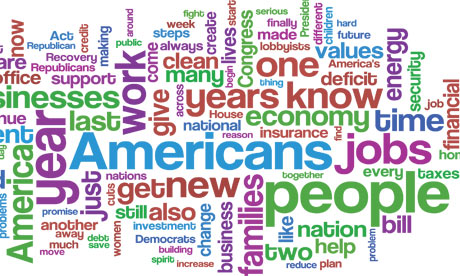
After the class discussions about Obama's State of the Union and the Wordle of his speech and the speeches of former presidents, I found myself most interested in the differences between Obama and Bush. Pictured on the top left is the Wordle of Obama's speech, while the bottom left is a Wordle compilation of all of Bush's State of the Union speeches.

The most used word in Obama's speech was Americans while Bush's was America. This is particularly reflective of each president's goal in office. After the economic downturn, individual Americans needed hope that things would turn out o.k. So it only seems natural that Obama would address the American people rather than America itself. Using Americans instead of America also connotes that Obama cares about every person in the United States, not just the country as a whole.

Bush probably used 'America' the most because his goals involved the direction of the country as a whole. As most of his presidency involved different wars, Bush was directing the involvement of America, not Americans, in multiple countries.

Another difference involves the second most common word used. Obama's was people while Bush's was must. Once again, Obama focused on solving problems within America and among the American people rather than problems involving foreign countries. His focus within the American population indicates why this would be the second most used word. After 9/11, Bush was in a state of urgency to react to the War on Terror. His urgency is reflected through the word 'must'. Bush created an enormous to-do list for America after 9/11, and in order to get those things accomplished Bush needed to use the word 'must'.

What else do you find interesting about these two Wordles? How do the words used reflect either Obama or Bush?

Saturday, January 9, 2010

Green Eggs and Ham


As a child I always asked my parents to read me Green Eggs and Ham by Dr. Seuss. In this classic kids novel, Sam (seen in the picture) tries to convince another character (whose doesn't have a name) to eat green eggs and ham. The other character is extremely reluctant to taste Sam's dish, no matter how or where Sam presents them to him. By the end the other character finally tries the green eggs and ham, and ends up loving them.

If you look at the book literally, one secret message might be to get kids to eat their meals. The unnamed characters ends up liking the green eggs and ham, which gives kids the idea that they will like the foods served at meals. Personally I was always a picky eater when I was little, so perhaps my parents always read me this book in order to get me to eat peas, for example. In this case parental compliance is suggested but certainly not in an extreme way.

The concept of trying new types of food can also be applied to a greater theme. Perhaps the idea of simply taking risks was meant to be conveyed through this book. Doing something you have never done before, like eating something crazy like green eggs and ham, might really what the story is all about. Although some secret messages are depicted as negative, I do not believe that is the case here. This is one secret message that is important for kids to learn, and one that is not harmful for a child's development.


Tuesday, January 5, 2010

Advertising to the Xtreme


Today in class we discussed the idea of advertising as brainwashing. In Pakistan, the Taliban has been "brainwashing" Pakistani children into becoming suicide bombers. Recently the Pakistani military found a destroyed compound in Nawaz Kot that was formerly used for this. The compound is painted with bright colors and beautiful landscapes filled with rivers and mountains which is meant to represent what is found in heaven. The picture below (from CNN.com) is an example.


The Taliban uses these paintings as their own form of advertising, along with elaborate stories about the paradise found after death, as a way to recruit new suicide bombers. Members of the Taliban make the children think their lives on Earth are being wasted when they could be in "Heaven" instead. Because the children are from places with terrible living conditions and violence they can easily be manipulated into believing the Taliban.

This certainly constitutes as brainwashing in my opinion, as it warps the childrens' perspectives on life and forces them to the unthinkable: death. So is brainwashing when you force someone to harm themselves physically? Or can it be emotional as well? What is your definition of brainwashing?

Monday, January 4, 2010

What Makes a Person Intriguing?

Browsing for an article to read on CNN.com, I noticed one called "Intriguing People for January 4th, 2010". The people described consisted of a top U.S. snowboarder, a famous architect, a political cartoonist, and Houston's first openly gay mayor. What I found most interesting, or I guess you could say 'intriguing', about this article was a section written at the bottom, which states how these intriguing people are chosen.

"Every day, there are a number of people who become fascinating to us -- by virtue of their character, how they reached their decision, how they behaved under pressure or because of the remarkable circumstances surrounding the event they are involved in... What they have done or said stimulates conversations across the country. At times, there is even a mystery about them... We want to know what makes them tick, why they believe what they do, and why they did what they did. They intrigue us."

After reading this statement and thinking about this topic for myself, I found that when I want to understand how and why a person thinks in a certain way I am intrigued. What strikes me about this passage, however, is that an 'intriguing' person is one who "stimulates conversation across the country". So, to be intriguing to a nationally recognized news site you must be nationally recognized as well. This doesn't seem appropriate to me. There isn't really a sense of mystery with already known and established people. I would rather learn why and how unknown people make a difference in the world.

What do you think? What/Who intrigues you?