So why would this person choose an unpopular name? Why do you think he kept his name anonymous in the first place? How does a hidden identity affect the way people perceive you?
Thursday, December 17, 2009
Santa Pete
In Evansville, Indiana, someone with the alias "Pete" annually donates money to the Easter Seals Rehabilitation Center. This article from CNN describes the history of Pete No one knows the true name of Pete, however he has donated around $65,000 to the center since 1990. This year Pete hid a miniature Christmas tree attached with $3000 for the staff to find in the rehabilitation center. Pete has made it clear that the money should be used to help the children at the center. One of the first children he helped in 1990, Kaitlin Thompson, has cerebral palsy. Now 23 years old, Kaitlin says that, "He's magical. He's special -- he keeps in mind people that are less fortunate."
This "Pete" is certainly a very giving person. But I am curious as to why he is keeping his identity hidden from the rest of the world. The article states that these types of philanthropists often remain anonymous out of "religious beliefs, personal humility, or wanting to be hit up by others hoping for a donation". It is also interesting that according to the Baby Name Wizard, Pete is not as common of a name as it used to be.
So why would this person choose an unpopular name? Why do you think he kept his name anonymous in the first place? How does a hidden identity affect the way people perceive you?
Friday, December 11, 2009
Rivalries
Tonight the annual New Trier vs Evanston boys and girls basketball games are taking place at Northwestern. The heated rivalry between these two schools has been going on since the early 20th century. I never really thought about it before, but now I am 'wondering' what fuels a rivalry in the first place. Both Evanston and New Trier participate in the Central Suburban South conference for athletics, and as such this is probably the most logical reason why the rivalry exists. So, location is one important factor in creating a rivalry.
After location is taken into account, it seems like competition takes over. The desire to win and to be better than another team sparks a rivalry. Being the best certainly results with an enormous amount of pride, another motivator for competition. This pride often leads to a sense of superiority. I know there will be lots of insults coming from both teams tonight in an attempt to gain this pride. The effects of a rivalry appear to result in pompous attitudes that I think are sometimes a little too disrespectful. I'm not saying that rivalries are a bad thing, because rivalry games are always really fun, but occasionally things are taken too far.
What do you think about rivalries? Should there be a moral component with a rivalry or not? What are some other causes for rivalries?
Monday, December 7, 2009
Tea Party Drama
The Tea Party movement is made up of local, state, and national groups that formed on April 15th, 2009, in response to Obama's economic policies. Named after the Boston Tea Party, this relatively new populist (populism means political ideas and activities that are intended to represent ordinary people's needs and wishes) movement now protests against a variety of Obama's policies including health care.
I recently read this article, which discusses the current state of the Tea Party. Right now, the group faces an inner-struggle with members who tend to act too extreme. John Feehery, a CNN contributor, stated that, "While most Tea Party activists are genuinely concerned about the future of the country, some others see conspiracies around every corner and use unacceptable rhetoric to communicate their displeasure with the president." There is fear that these "fringe" members of the group are tainting the public's opinion of the Tea Party and therefore the public's support.
This conflict within the Tea Party addresses the idea of effective free speech. In this circumstance, the overall goal of the Tea Party is to express dislike Obama's policies to make them change. The best way to do this is to gain supporters, but the extremists within the group are preventing that goal from being achieved. Free speech is actually hindering the success of the Tea Party, and that makes me think about which types of free speech are the most effective.
What do you think? What types of free speech are the most effective? Is free speech more effective in certain situations or at certain times?
Tuesday, December 1, 2009
Previewing Obama's Speech
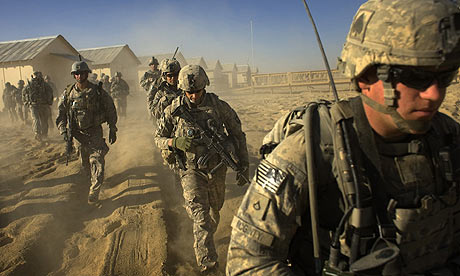
The article contains a paragraph that describes Senator John McCain's (Obama's opposing presidential candidate) opinion on the troop surge. McCain agrees with Obama's plan to increase the amount of soldiers in Afghanistan, however he argued against setting a time table.
He stated, "Dates for withdrawal are dictated by conditions. The way that you win wars is to break the enemy's will, not to announce dates that you are leaving."
I find that this perfectly addresses what we discussed today in class. Obama will be informing the American public about the schedule for US involvement in Afghanistan, but McCain believes this information should be kept secret. This suggests that in this circumstance, a military strategy should not be revealed.
My take is that the public does indeed have the right to know. The troops in Afghanistan are American people, whose lives matter to thousands of families across the country. Obama owes it to families whose sons or daughters are putting their lives on the line to know when withdrawl is expected. I see McCain's point, however he should certainly understand this as well considering he was in the Navy for 22 years.
What do you think? Is it important that the American people know what to expect in Afghanistan in these next few years? What would happen if we did not find out?
Subscribe to:
Posts (Atom)